How to Create a Pain Diary Doctors Will Actually Read


You know the specific kind of exhaustion that comes after a doctor’s appointment where nothing happened.
You waited three months for the slot. You took time off work. You sat on the crinkly paper, rehearsing exactly what you were going to say. You tried to explain that the pain isn’t just "bad cramps"—it’s pain that stops you from walking, from thinking, from being a person.
And then they looked at your normal ultrasound, shrugged, and suggested ibuprofen. Again.
It feels personal. It feels like they think you’re lying, or dramatic, or weak. But after speaking with hundreds of patients and specialists, we’ve learned that the problem often isn’t malice. It’s a language barrier.
You are speaking the language of experience—how the pain feels, how it scares you, how it ruins your week. Doctors are trained to speak the language of data—location, frequency, duration, and functional impact.
To get a diagnosis for complex conditions like endometriosis, adenomyosis, or PCOS, you have to bridge that gap. You have to translate your suffering into evidence they can’t ignore.
The memory trap
Here is the cruelest part of chronic pain: it destroys your ability to remember it accurately.
When you are in a flare, it feels like you have always been in pain and always will be. But when the pain lifts, your brain tries to protect you by making the memory fuzzy. It’s a survival mechanism.
So when a doctor asks, "How many days last month were you in severe pain?", you might hesitate. You might say "a lot," or "I think most days."
To a medical provider, "a lot" is an opinion. "17 days" is a clinical fact.
Doctors look for patterns to distinguish between conditions. If you can’t provide specific data points, they default to the simplest explanation (usually "normal period pain") and the simplest treatment (painkillers or birth control).
What doctors actually need to see
We’ve seen patients bring in handwritten journals, color-coded spreadsheets, and notes on their phones. Most of these get glanced at for five seconds and set aside.
Why? Because they are often too dense or too unstructured to absorb in a 15-minute appointment.
To make a doctor sit up and pay attention, your tracking needs to focus on three specific things:
1. the "where" (be specific)
"Pelvic pain" is too vague. Your pelvis contains your uterus, ovaries, bladder, bowel, and pelvic floor muscles.
- Does the pain shoot down your leg? (Could be sciatic nerve involvement)
- Is it deep in your rectum? (Could be bowel endometriosis)
- Is it one-sided near your hip? (Could be ovarian cysts or adhesions)
Pinpointing the exact location helps doctors visualize the disease anatomy before they even open you up.
2. the "what you couldn't do" (functional impact)
Forget the 1-10 pain scale. Everyone’s 7 is different, and chronic pain warriors often downplay their numbers because they’re used to functioning in agony.
Instead, track function.
- Can you walk upright?
- Did you vomit?
- Did you miss work or school?
- Did you have to cancel social plans?
- Did you faint?
"I had 8/10 pain" is subjective. "I was unable to stand for three hours and vomited twice" is objective medical history.
3. the pattern
This is the most critical piece for diagnosis.
- Endometriosis often causes pain that starts before bleeding and can be distinct from cramps.
- Adenomyosis typically presents with a heavy, boggy feeling and prolonged bleeding.
- PCOS might show irregular gaps between cycles with specific ovarian pain.
If you only say "it hurts on my period," you miss the nuance. Does it hurt during ovulation? Does it hurt during bowel movements? Does it hurt during sex? These timing clues are the map to your diagnosis.
The tool that does the heavy lifting
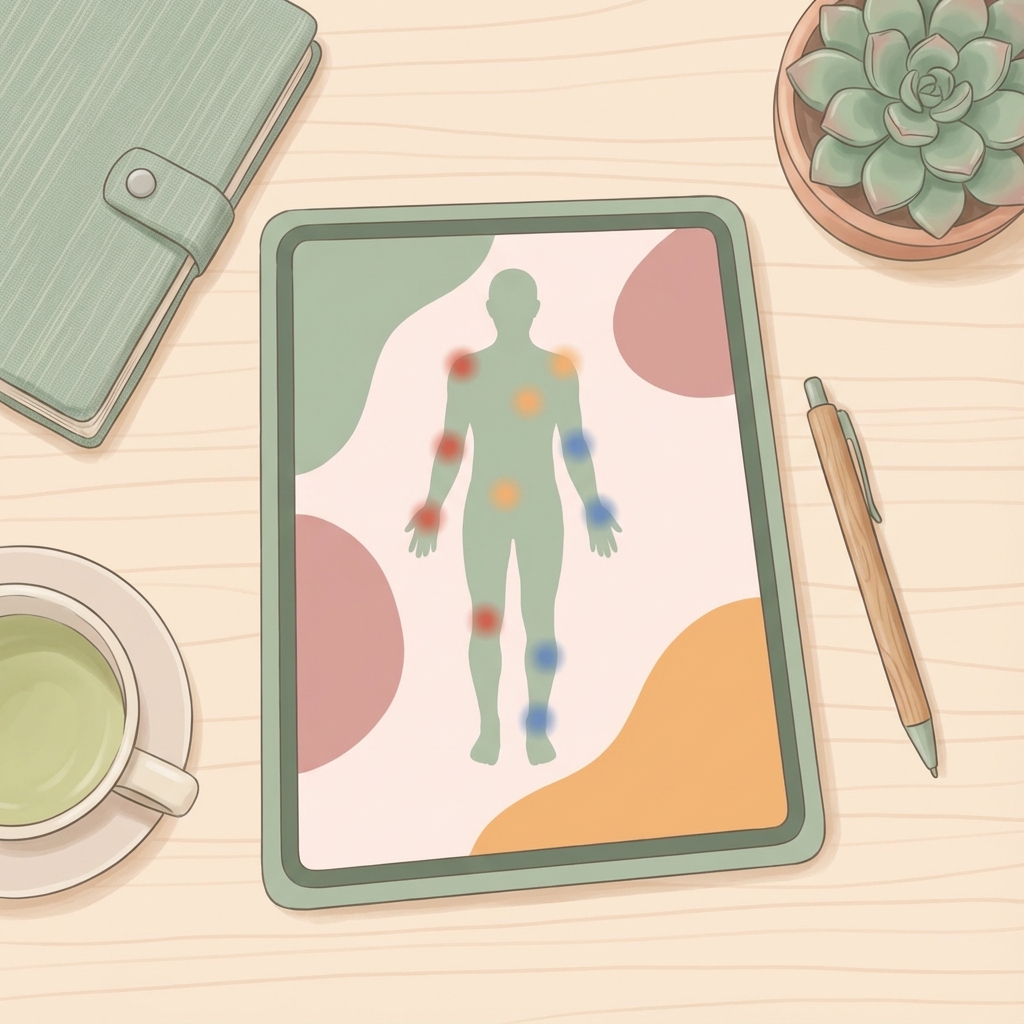
We built Endolog because we were tired of seeing patients dismissed for lacking "proof."
Tracking all of this manually—dates, locations, intensity, triggers, medications—is a full-time job. And when you’re in pain, you don’t have the energy to manage a complex spreadsheet.
Endolog is designed to be the bridge between you and your doctor.
- Tap to track: Log symptoms in seconds, even when you’re curled up in bed.
- Visual body mapping: Show exactly where it hurts, not just tell.
- Smart correlations: The app notices patterns you might miss (e.g., "You tend to report left-sided pain on day 14 of your cycle").
Most importantly, Endolog generates a clean PDF report for your doctor.
This isn’t just a list of symptoms. It’s a medical summary designed for that 15-minute appointment window. It aggregates your data into clear visualizations: "Patient reports severe functional impairment 6 days per month; pain correlates with ovulation and menstruation; NSAIDs provide minimal relief."
It turns your experience into the data they respect.

Your pain is real
You shouldn’t have to work this hard to be believed. In a better world, you could just say "I’m hurting," and that would be enough.
But until the medical system changes, data is your best advocate.
When you walk into that office with a clear, concise record of your reality, you shift the power dynamic. You move the conversation from "Are you sure it’s that bad?" to "Here is the evidence. What are we going to do about it?"
You know your body. Now, give them the proof they can't ignore.
Explore this topic
Related articles
March 21, 2026
15 Expert Questions to Ask Your Doctor About Endometriosis
Prepare for your next medical appointment with these 15 essential questions about endometriosis diagnosis, excision surgery, and managing chronic pelvic pain.
December 18, 2025
Why Diagnosing Endometriosis Takes 7 Years (And How to Speed It Up)
The average endometriosis diagnosis takes 7 to 11 years and involves four to five different doctors. Here's why the system fails patients and what you can do to get answers faster.
March 18, 2026
Can You Have Endometriosis and Adenomyosis Together?
Learn about the 42% comorbidity rate of endometriosis and adenomyosis, how symptoms overlap, and why tracking with Endolog helps get an accurate diagnosis.
March 13, 2026
Body Mapping for Pelvic Pain: Showing Doctors Where It Hurts
Learn how pelvic pain mapping helps identify conditions like endometriosis. Create a visual guide of your symptoms to help your doctor find accurate answers.
February 25, 2026
"It's Just a Bad Period": Fighting Endometriosis Dismissal
Tired of having your period pain dismissed by doctors? Learn the red flags of endometriosis and how to advocate for your health with accurate data tracking.
February 7, 2026
How to Talk to Your Doctor About Severe Period Pain
Struggling to be heard? Learn how to talk to your doctor about period pain with practical tips, script ideas, and tracking methods for a better diagnosis.