Painful Periods After a C-Section: Causes and When to Worry

Are periods more painful after a C-section?
They can be. A C-section can leave adhesions, which are bands of internal scar tissue, a small pouch in the womb scar called a niche or isthmocele, or, rarely, endometriosis in the scar. These can cause pelvic pain or more painful periods. Causes unrelated to the surgery, such as adenomyosis or fibroids, are also possible.
Period pain is often a normal part of the menstrual cycle. But if your periods become more painful, heavier or irregular, or the pain stops your daily activities, see a GP. This guide explains each cause, the signs that point to it, and what to tell your doctor. It is general information. Your own doctor decides what is right for you.
How C-section affects your uterus
In a C-section, the surgeon makes a cut through the wall of your tummy and then a second cut through the wall of your womb (uterus). Both cuts heal with scar tissue.
Most scars heal without problems. The skin scar is often red and obvious at first, but it should fade with time. Inside the body, healing can sometimes leave:
- Adhesions. Bands of scar tissue that join organs or tissues that are normally separate.
- A niche (isthmocele). A dent or pouch in the womb scar.
- Endometriosis in the scar. Tissue like the womb lining that grows in the scar in the tummy wall.
Healing and recovery
Most women have some discomfort for the first few days after a caesarean. For some, the pain can last several weeks. You may not feel ready to drive, exercise or have sex for 6 weeks or so.
To help the wound heal, take these steps:
- Gently clean and dry the wound every day
- Wear loose, comfortable clothes and cotton underwear
- Look out for signs of infection
Some scar problems, such as scar endometriosis, can show up years after the C-section. A scar niche does not go away on its own, but not every niche needs treatment.
Why C-section can cause painful periods
Adhesions and scar tissue
Adhesions are common after a C-section. In a UK study of 308 women who had one or more C-sections more than a year before, ultrasound showed pelvic adhesions in 45%. The most common place was between the womb and the bladder.
In that group:
- More C-sections made adhesions at the front of the pelvis more likely.
- A wound infection after the operation also made them more likely.
- Women with adhesions were more likely to have chronic pelvic pain.
Chronic pelvic pain is not tied only to period days. If you have pain at other times of the month too, tell your doctor.
Isthmocele (C-section scar niche)
An isthmocele, also called a cesarean scar defect or niche, is a small pouch or dent of scar tissue in the front wall of the womb. It forms when the womb cut does not heal fully.
Some degree of niche shows up in about 2 to 7 out of 10 women who have had at least one C-section. Many have no symptoms. When symptoms happen, they can include:
- Painful periods
- Spotting or bleeding between periods
- Irregular periods
- Pelvic pain
- Pain during sex
- Difficulty getting pregnant
If you notice spotting between periods, write down the dates so your doctor can see the pattern.
Endometriosis in the C-section scar
Scar endometriosis is rare, but it is important to know about. During a C-section, cells from the womb lining can get into the wound. Some of these cells can survive and grow in the scar.
In a study of 198 women who had surgery for C-section scar endometriosis:
- Almost all (98.5%) had a lump in the tummy wall.
- Most (86.9%) had pain that came and went with their cycle.
- Symptoms started on average about 2.5 years after the C-section.
- Most lumps (83%) were at a corner or end of the scar.
So, a lump at or near your scar that gets bigger or hurts around your period is a reason to see a doctor. All the women in that group had surgery to remove the lump.
Other causes of period pain
A C-section is not always the cause. Other causes of period pain include:
- Endometriosis, where tissue like the womb lining grows in other places, such as the ovaries and fallopian tubes
- Adenomyosis, where this tissue grows into the muscle of the womb
- Fibroids, which are non-cancerous growths in or around the womb
- Pelvic inflammatory disease, an infection of the womb, fallopian tubes and ovaries
- An intrauterine device (IUD), mainly in the first 3 to 6 months after it is fitted
Our guides to painful periods, endometriosis symptoms and adenomyosis symptoms explain these conditions in more detail.
Normal vs. concerning post-C-section period changes
Some period pain is normal. See a GP if:
- Your periods become more painful, heavier or irregular
- Period pain stops you from doing your normal activities
- You have pain during sex, or when you pee or poo
- You bleed between periods
Also see a doctor if you notice:
- A lump at or near your C-section scar
- Pain or swelling at the scar that comes back around your period
- Spotting between periods, or trouble getting pregnant
Diagnosing post-C-section period pain
Your doctor will ask about your C-section and how your periods have changed. They may examine your tummy, your scar and your pelvis.
Tests depend on what your doctor suspects:
- Transvaginal ultrasound. This is usually the first test for a scar niche. Transvaginal and tummy scans can also show adhesions.
- Saline infusion sonohysterogram. Fluid fills the womb during an ultrasound, so the niche is easier to see.
- Hysteroscopy. A thin camera goes into the womb through the vagina to look at the scar.
Treatment options
Treatment depends on the cause.
For period pain in general, these steps can help:
- A warm bath or shower
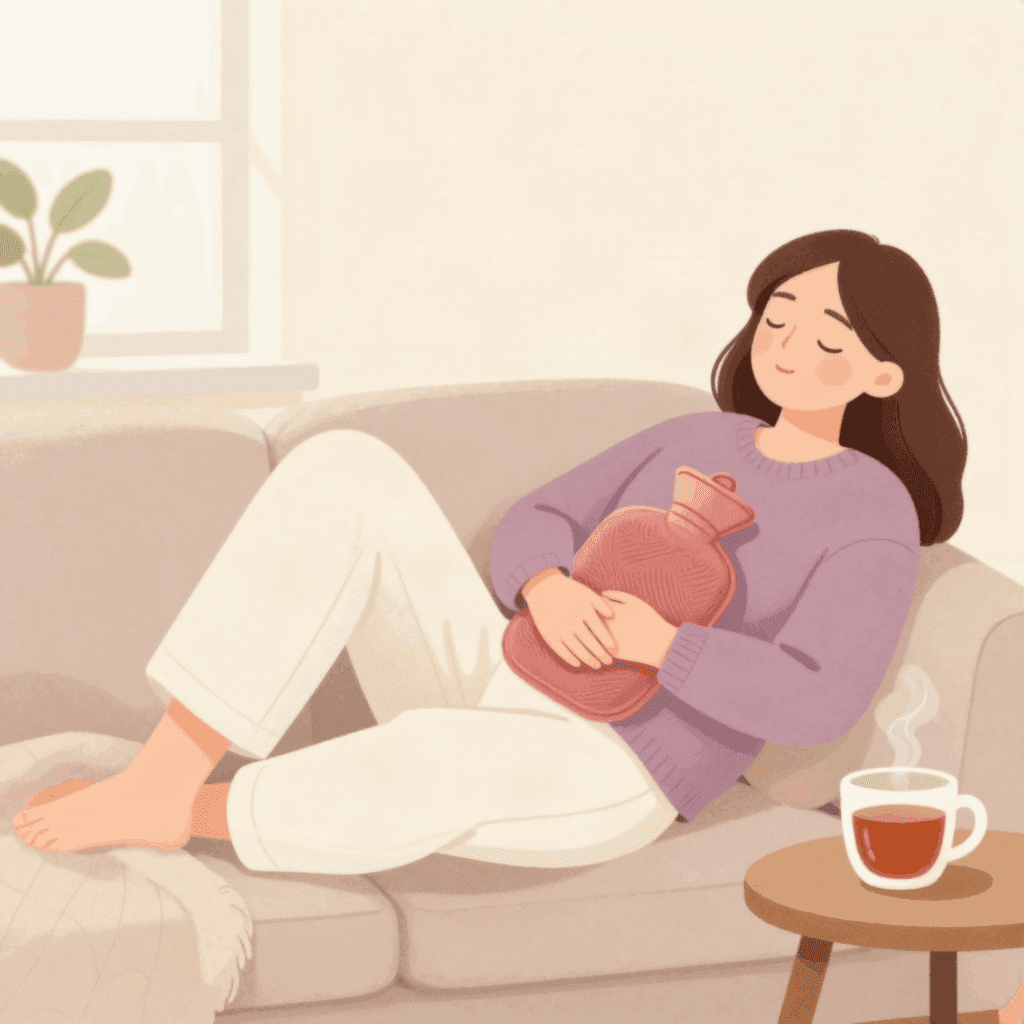
- A heat pad, or a hot water bottle wrapped in a tea towel, on your tummy
- Gentle exercise like yoga, swimming, walking or cycling
- Painkillers like paracetamol or ibuprofen
- Less alcohol, and no smoking
For a scar niche, treatment options include:
- Hormonal medicine, such as birth control, to control periods and reduce bleeding
- Hysteroscopic repair, which removes scar tissue through the vagina
- Laparoscopic repair, which is keyhole surgery through the tummy
For scar endometriosis, surgery to remove the lump is the usual treatment.
Managing painful periods after C-section
Tracking your symptoms
A written record helps your doctor find the cause. Each day, note:
- Cycle day. Day 1 is the first day of bleeding.
- Pain level from 0 to 10, and where it is: low tummy, back, or at the scar.
- The scar. Any lump, swelling or tenderness, and if it changes around your period.
- Bleeding. Light, medium or heavy, and any spotting between periods.
- Other signs. Pain during sex, or when you pee or poo.
- What helped. Painkillers, heat or rest, and how well they worked.
After 2 to 3 cycles, you can show your doctor when the pain comes and how it lines up with bleeding. Our guide to a pain diary for your doctor explains how to share a record like this.
Endolog is a pain and symptom diary app. You can log pain, bleeding and scar symptoms on the same day, so your doctor sees them side by side.
When to seek help
Schedule a doctor visit
Make an appointment if:
- Your periods are more painful, heavier or irregular than before
- The pain stops you from doing your normal activities
- You have a lump, swelling or pain at your scar that comes and goes with your cycle
- You have pain during sex, or bleeding between periods
Get urgent help
Ask for an urgent GP appointment or call NHS 111 if your period pain is severe or worse than usual and painkillers have not helped. Also get urgent advice if you have pelvic pain and:
- A very high temperature, or you feel hot, cold or shivery
- Unusual discharge, fluid or bleeding from your vagina
- You are pregnant or may be pregnant
Call 999 or go to A&E if you have pelvic pain and:
- It is severe, getting worse, or hurts when you move or touch the area
- You feel faint, dizzy or lightheaded, or you pass out
- You have heavy bleeding from your vagina
- You have difficulty breathing
If your C-section was recent, contact your midwife or GP at once if your wound gets more red, painful and swollen, or if pus or foul-smelling fluid comes from it.
In the US, call 911 in an emergency.
FAQ: painful periods after C-section
Can adhesions from C-section cause period pain?
They can. Adhesions are common after a C-section. In one study, ultrasound found pelvic adhesions in 45% of women who had a C-section more than a year before, and women with adhesions were more likely to have chronic pelvic pain. Tell your doctor if you have pelvic pain on period days and at other times. The section on adhesions and scar tissue has more detail.
Why does my C-section scar hurt during my period?
A lump at the scar that hurts or swells around your period can be a sign of scar endometriosis. Most people with it have a lump and cyclic pain, and symptoms start on average about 2.5 years after the C-section. See a doctor to have it checked.
How long does it take for periods to normalize after C-section?
There is no set time. Pain from the operation itself can last several weeks. If your periods stay more painful, heavier or irregular than before, see a GP. A lump or pain at the scar can also start years later, so have any new scar symptoms checked.
Can I prevent painful periods after C-section?
Not every cause can be prevented. A wound infection after the operation makes adhesions more likely. So gently clean and dry the wound every day, and get help quickly if it shows signs of infection. If your periods get more painful, see a doctor early so the cause can be found and treated.
Should I tell my doctor about period changes after C-section?
Yes. Tell your doctor if your periods are more painful, heavier or irregular than before, and about any lump, swelling or pain at your scar. A record of 2 to 3 cycles makes the pattern easier to see. Our pain diary for your doctor shows what to write down and how to share it.
Related articles
- Painful Periods: Causes, Severity, ICD-10, and What Helps
- The Complete Guide to Endometriosis Symptoms
- Adenomyosis Symptoms
- Pain Diary for Your Doctor
This article is for general information. It does not replace care from a doctor. If you think you have an emergency, call 911 in the US, or 999 in the UK.
Sources
- Cesarean scar endometriosis: presentation of 198 cases and literature review (Zhang P, et al. BMC Women's Health, 2019), PubMed
- Prevalence of pelvic adhesions on ultrasound examination in women with a history of Cesarean section (Moro F, et al. Ultrasound in Obstetrics & Gynecology, 2015), PubMed
- Isthmocele (Cesarean Scar Defect), Cleveland Clinic
- Period pain, NHS
- Pelvic pain, NHS
- Caesarean section: recovery, NHS
This article is general information, not medical advice. Read how we write and check our articles in our editorial policy.
Explore this topic
Related articles
October 6, 2026
Ibuprofen or Naproxen for Period Cramps: Which and When
Ibuprofen for period cramps works about as well as naproxen. See how often to take each, when to start, who should avoid them and when to see a doctor.
October 5, 2026
Heating Pads for Endometriosis and Period Pain: Safe Use
How to use a heating pad for endometriosis and period pain: how hot, how long, where to put it, why not to sleep on it, heat rash, and when to see a doctor.
October 3, 2026
What Helps With Period Cramps? Options With Evidence
What helps with period cramps: anti-inflammatory painkillers taken early, heat, exercise and hormonal birth control. See the evidence and when to get help.
January 4, 2026
Does PCOS Cause Painful Periods? What the Link Is
Does PCOS cause painful periods? Learn how PCOS affects period pain, why some people with PCOS have bad cramps and others do not, and when to worry.
December 28, 2025
Painful Periods in Perimenopause: Why Your 40s Feel Different
Periods can get more painful in perimenopause. Learn why periods change in your 40s and 50s, and which kinds of pain need a doctor's check.
December 19, 2025
Painful Periods: Causes, Severity, ICD-10, and What Helps
Painful periods explained: causes, severity scales, heavy or irregular patterns, period pain in your 40s, the ICD-10 code, and when to see a doctor.
