Ovary Pain or Appendicitis? How to Tell, and When to Go to the ER


You cannot safely tell ovary pain from appendicitis at home, because both can hurt low on the right side of your belly. Pain that starts near your belly button, moves to the lower right and gets worse over a few hours points to appendicitis and needs emergency care; short pain in the middle of your cycle that switches sides from month to month fits ovulation.
Go to the emergency room now, or call 911 (999 in the UK), if you have pain low on the right side and any of these:
- The pain started around your belly button, moved to the lower right, and keeps getting worse (NHS).
- You have a fever, or you feel sick or are vomiting (Cleveland Clinic).
- The pain gets worse when you move or cough, or when you press on the spot and then let go (NHS, Cleveland Clinic).
- The pain came on suddenly and is severe, or it keeps coming and going on one side (ACOG).
- You feel faint or very dizzy, or you look very pale (NHS).
- You could be pregnant, even if you have not had a positive test (NHS).
Do not drive yourself. Do not wait to see if it settles, and do not wait to log it first.
The rest of this guide explains why these signs matter. It is not a way to rule out an emergency.
Why the two are easy to confuse
The appendix and the right ovary sit close to each other. Pain from organs deep in the belly is hard to place, so the brain maps both to roughly the same spot on the skin.
Doctors find this hard too. Cleveland Clinic notes that only about half of people with appendicitis have the classic pattern of symptoms, and that conditions of the pelvic organs, including ovarian cysts and endometriosis, can feel very similar (Cleveland Clinic). The NHS says there is no test that can always show appendicitis (NHS). For a twisted ovary, the American College of Obstetricians and Gynecologists (ACOG) says in its guidance on young patients that no symptom or scan can confirm it before surgery (ACOG Committee Opinion 783).
So the aim of this page is narrow. It helps you notice the patterns that mean "go now". It also helps you describe your pain clearly when you get there.
Where the appendix and the right ovary sit
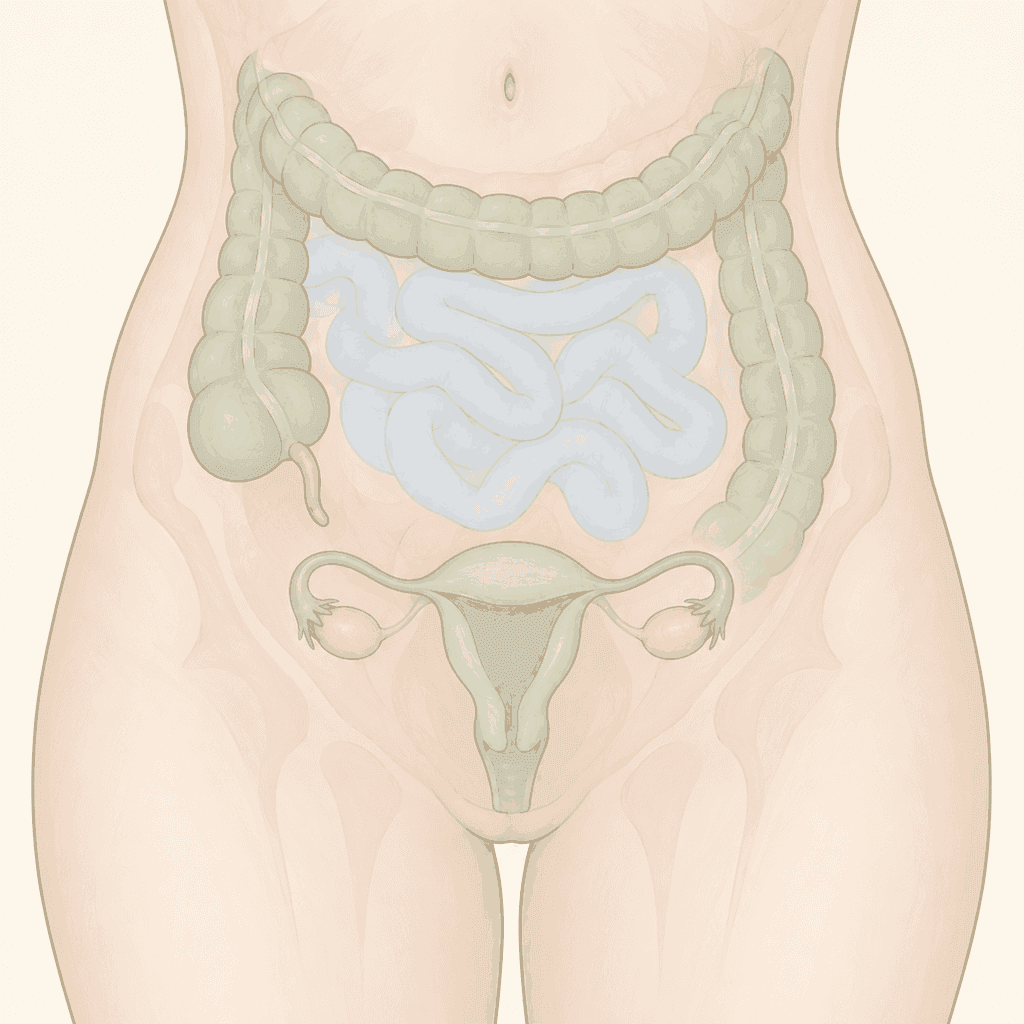
This is a front view, so the body's right side is on your left as you look at it. The appendix (the small tube at the bottom of the green large intestine) hangs low on the body's right. The ovaries (pink) sit lower in the pelvis, one on each side of the uterus. The areas overlap, so where the pain is cannot tell you its cause.
The appendix is a small pouch of bowel. It most often sits at a spot doctors call McBurney's point. To find it, picture a line from the bony point at the front of your right hip to your belly button. The point is about one third of the way along that line from the hip (Cleveland Clinic). The appendix can also lie in other places, such as behind the bowel (Cleveland Clinic). This is one reason its pain does not always follow the textbook.
The ovaries sit lower, inside the bony ring of the pelvis, one on each side of the uterus. Pain from the right ovary is often felt low in the right groin or deep in the pelvis. It can also spread to the lower back or the thigh.
The two areas overlap. The spot you point to cannot tell you which organ is the source.
How appendicitis pain starts and moves
The most useful clue is how the pain travels over time.
Appendicitis pain usually starts in the middle of the belly, around the belly button. After a few hours it moves to the lower right side and gets worse (NHS). At first the pain may come and go. It then gets stronger, and nausea and vomiting often follow (Cleveland Clinic).
Other signs that point to the appendix:
- The pain is worse when you move, cough or press on the area. It may ease a little if you pull your knees up to your chest (NHS).
- Pressing on the sore spot hurts more when the pressure is let go. Doctors call this rebound tenderness (Cleveland Clinic).
- You lose your appetite, feel sick, or have a high temperature. Constipation, diarrhea or peeing more often can also happen (NHS).
- The pain does not follow your cycle. It can start on any day, including during your period.
Time matters. Cleveland Clinic states that the appendix can burst within 36 hours of the first symptoms (Cleveland Clinic). If it bursts, the pain may ease for a short time. Severe pain across the whole belly then usually follows (NHS). A short break in the pain is not a sign that you are getting better.
Some people do not get the usual pattern. The pain can be milder, grow more slowly, or sit in a different place. This is more likely if you are pregnant (NHS).
How ovary pain starts and moves
"Ovary pain" covers several causes. Most are harmless. Two of them are emergencies.
Ovulation pain
Ovulation pain comes about 14 days before a period. It can feel like a dull ache or sharp, sudden twinges. It lasts from a few minutes to 1 or 2 days. It is on one side at a time and can switch sides from month to month, based on which ovary releases the egg (NHS).
Unlike appendicitis, ovulation pain does not start at the belly button and travel. It also does not keep getting worse over hours. The NHS advises urgent care for belly pain that is severe and not helped by painkillers, pain that keeps coming back, or pain when you think you may be pregnant (NHS).
Ovarian cyst pain
Most ovarian cysts cause no symptoms. Some cause a dull or sharp ache, or pain during certain activities (ACOG). For more detail on how different cysts feel, read what ovarian cyst pain feels like.
If your one-sided pain comes back with each period, this guide to ovary pain during your period covers the common causes. The guide to one-sided pelvic pain during your period explains how the side of the pain helps a doctor.
Other emergencies that can feel like appendicitis
Ovarian torsion
Torsion means the ovary twists on the tissue that holds it, which can cut off its blood supply. It is a surgical emergency. ACOG lists twisting of the ovary and tube as the fifth most common gynecologic emergency (ACOG Committee Opinion 783).
How it usually feels:
- The pain is on one side. It can start suddenly, or it can come and go (ACOG).
- Nausea and vomiting are common (ACOG Committee Opinion 783).
- It does not start at the belly button and then move, as appendicitis often does.
Torsion is often linked to a cyst or growth on the ovary, and the risk goes up when a mass in the pelvis is larger than 5 cm. In ACOG's review of young patients, 64% of torsions were on the right side. ACOG links this to the large bowel on the left side, which seems to protect the left ovary (ACOG Committee Opinion 783). So torsion tends to hurt on the same side as the appendix.
Speed saves the ovary. ACOG advises quick keyhole surgery when torsion is suspected, to protect ovarian function and future fertility. A normal blood flow result on an ultrasound does not rule torsion out (ACOG Committee Opinion 783).
If you have a known cyst and get sudden one-sided pain with vomiting, say so at the ER desk.
A cyst that bursts or bleeds
A cyst that bleeds or bursts can cause sudden, severe pain (ACOG). The NHS lists a ruptured ovarian cyst among the conditions to think of when you are not sure the pain is appendicitis (NHS). You cannot tell at home how much a cyst has bled. Pain that started suddenly and stays severe needs the ER.
Ectopic pregnancy
If there is any chance you are pregnant, think of ectopic pregnancy. This is a pregnancy that grows outside the womb, most often in a fallopian tube. Symptoms can include pain low down on one side, vaginal bleeding or brown watery discharge, pain in the tip of the shoulder, and discomfort when you pee or poo. They usually start between week 4 and week 12 of pregnancy (NHS).
Sharp, sudden, intense belly pain with dizziness, fainting, nausea or a very pale look can mean the tube has burst. This is life-threatening, so call for an ambulance (NHS).
A side-by-side look
These are typical patterns. Real cases often do not match them, so use this table to describe your pain, not to decide whether to go.
| Appendicitis | Ovulation pain | Ovarian torsion | Burst or bleeding cyst | |
|---|---|---|---|---|
| How it starts | Near the belly button, then moves to the lower right over a few hours | Mid-cycle, one side | Sudden, or comes and goes, one side | Sudden, one side |
| Over time | Keeps getting worse | Fades within minutes to 2 days | Can be severe and keep returning | Can be severe; may ease or get worse |
| Other signs | Loss of appetite, nausea, vomiting, fever | Sometimes a little bleeding or discharge | Nausea and vomiting are common | Feeling faint is a warning sign |
| Timing | Any day | About 14 days before a period | Any day, more likely with a cyst | Any day |
| What to do | ER now | Painkillers; see a doctor if severe or recurring | ER now | ER if severe |
What happens at the hospital
Doctors will feel your belly for tender spots. You may have blood tests, a urine test and an ultrasound or CT scan. You will usually be asked for a pregnancy test if there is any chance you are pregnant (NHS). Sometimes doctors watch you for a few hours to see how the pain changes (NHS).
Clear answers to these questions help the team:
- What time did the pain start, and where was it at first?
- Has it moved, and when?
- Is it steady, or does it come in waves?
- What is your pain score now, compared with an hour ago?
- When did your last period start, and where are you in your cycle?
- Have you vomited, had a fever, or felt faint?
- Do you have a known ovarian cyst, endometriosis, or a chance of pregnancy?
What tracking can and cannot tell you
A pain diary cannot diagnose appendicitis or torsion. It cannot tell you that a new, severe pain is safe to wait out. If you have any of the signs in the box at the top, go now and log it later, or not at all.
Tracking helps in other ways. If you have logged your cycle and your usual pain, you know your baseline. A mid-cycle twinge that shows up each month and switches sides is a pattern you can point to. A new pain that breaks that pattern is easier to spot, and easier to explain to a doctor. After an ER visit, notes on when the pain started and how it moved can help at follow-up.
For recurring right-sided pain that is not an emergency, you can log where it hurts, when in your cycle it starts and how long it lasts in Endolog. A few months of entries give your doctor a clearer picture than memory alone.
Frequently asked questions
How do I know if it's my ovary or my appendix?
You cannot know for sure at home. Pain that starts around the belly button, moves to the lower right and gets worse over hours points to the appendix. Short, mid-cycle pain that switches sides points to ovulation. Sudden severe one-sided pain with vomiting can be ovarian torsion. Any pain that keeps getting worse, or comes with fever, vomiting or faintness, needs the ER.
What is the difference between appendicitis and ovulation pain?
Ovulation pain comes about 14 days before a period, lasts from minutes to 1 or 2 days, and can switch sides each month. Appendicitis pain does not follow your cycle. It often starts near the belly button, moves to the lower right, and keeps getting worse, often with loss of appetite, nausea or fever.
Is the appendix higher than the right ovary?
Usually, yes. The appendix most often sits in the lower right belly, about one third of the way from the front of the right hip bone to the belly button. The right ovary sits lower and deeper, inside the pelvis beside the uterus. The two areas overlap, and the appendix can lie in other positions, so location alone cannot tell them apart.
Can appendicitis pain come and go?
Yes, early on. The first pain around the belly button may come and go for several hours before it moves to the lower right and becomes constant. If the pain suddenly eases after it was severe, the appendix may have burst, and severe pain across the whole belly often follows. Get emergency care.
Can ovarian torsion feel like appendicitis?
Yes. Torsion causes one-sided lower belly pain, often with nausea and vomiting, and in young patients it is more common on the right. Its pain tends to start suddenly or come in waves, but only an exam and scans, and sometimes surgery, can tell the two apart. Both need emergency care.
This article is for general information. It does not replace care from a doctor. If you think you have an emergency, call 911, or 999 in the UK.
Sources
- Appendicitis, NHS
- Appendicitis, Cleveland Clinic
- Ovulation pain, NHS
- Ovarian Cysts, American College of Obstetricians and Gynecologists (ACOG)
- Adnexal Torsion in Adolescents (Committee Opinion No. 783), American College of Obstetricians and Gynecologists (ACOG)
- Ectopic pregnancy, NHS
This article is general information, not medical advice. Read how we write and check our articles in our editorial policy.
Explore this topic
Related articles
January 6, 2026
What Ovarian Cyst Pain Can Feel Like
Ovarian cyst pain can be a dull ache, pressure, or sudden sharp pain. Learn what each type can feel like and when cyst pain needs urgent care.
December 29, 2025
Ovary Pain During Your Period: Left, Right, or Both Sides
Ovary pain during your period explained: left vs right, one side vs both, twinges, deep aches, and when to investigate cysts or endometriosis.
December 26, 2025
Period Cramps on One Side: Is It Normal? When to Worry
One-sided period cramps are often harmless. See which causes to check, and which signs need a doctor fast, such as fever, fainting, or sudden severe pain.
January 3, 2026
Sudden Stabbing Pelvic Pain: How It Feels and When It Repeats
Sudden stabbing pelvic pain can be alarming. Learn the common causes of sharp pelvic pain, what to track, and which signs need urgent care.
December 30, 2025
Pain After a Ruptured Ovarian Cyst: What People Notice
Pain after a ruptured ovarian cyst follows a specific pattern. Understanding what to expect helps you distinguish normal recovery from concerning symptoms.
March 22, 2026
Left Side Pelvic Pain: Common Causes and What It Means
Discover potential causes for left side pelvic pain, from endometriosis to PCOS. Learn how to track your symptoms effectively for better doctor consultations.