Endo Belly Diet: What Helps and How to Find Your Triggers
No diet cures endo belly, but a change in what you eat can ease the bloating for some people. The endo belly diet with the best evidence is a short low-FODMAP diet with a dietitian, and a food diary for bloating shows which foods matter for you.
What is endo belly?
Endo belly is the bloating and swelling of the tummy that many people with endometriosis get. In one small study, 96% of women with endometriosis had abdominal bloating, against 64% of women without it. In the same study, the size of the lower tummy changed more across the cycle in women with endometriosis who took no hormone treatment than in women without endometriosis.
Bloating also has common causes that are not endometriosis. The most common one is a lot of gas in your gut, from food, fizzy drinks or swallowed air. Constipation, food intolerance, coeliac disease and IBS can also cause it. For why endometriosis causes bloating, read endo belly: causes, symptoms and what helps.
Can diet help endo belly?
No treatment can cure endometriosis at this time, and no diet changes that. A diet can only target the gut symptoms that come with it, such as bloating, tummy pain and changes in your poo. Be careful with any plan that promises to treat endometriosis itself.
The low-FODMAP diet
FODMAPs are carbohydrates that are found in many foods, for example onions, garlic, beans, lentils, many wheat products, apples, stone fruits and dairy.
The best test of this diet in endometriosis is a small trial. Of 35 women with endometriosis and gut symptoms, 60% improved on a 28-day low-FODMAP diet, against 26% on a control diet. Bloating, tummy pain, stool form and quality of life were all better on the low-FODMAP diet.
The evidence is still thin. Only five studies have tested the low-FODMAP diet in endometriosis, and most of them were small or not randomised. They support it as a dietitian-guided option for gut symptoms in some patients, mainly people with tummy pain, bloating, constipation or IBS-like symptoms. It is not a diet for everyone with endometriosis.
The diet has three phases:
- Elimination: you stop high-FODMAP foods for at least 2 and no more than 6 weeks.
- Reintroduction: you add the foods back one group at a time and see which ones cause symptoms.
- Maintenance: you eat a diet that suits you, with only the foods that cause symptoms limited.
The low-FODMAP diet is not meant to be permanent. Do it with a dietitian, so you still eat a balanced diet. If you need to avoid lots of different foods to control your symptoms, see a GP, who may refer you to a dietitian.
Other changes that can ease bloating
These changes are low risk, and you can try them before a stricter diet:
- Eat smaller meals more often, and eat with your mouth closed so that you swallow less air.
- Drink plenty of water, and have fewer fizzy drinks, less alcohol and less caffeine.
- Exercise regularly.
- If you are constipated, eat foods with soluble fibre, such as oats or linseed.
- For wind and bloating, eat fewer foods that are hard to digest, such as cabbage, broccoli, cauliflower, beans and onions, and avoid the sweetener sorbitol.
For a wider way of eating, read about the anti-inflammatory diet for endometriosis.
Why keep a food diary for bloating
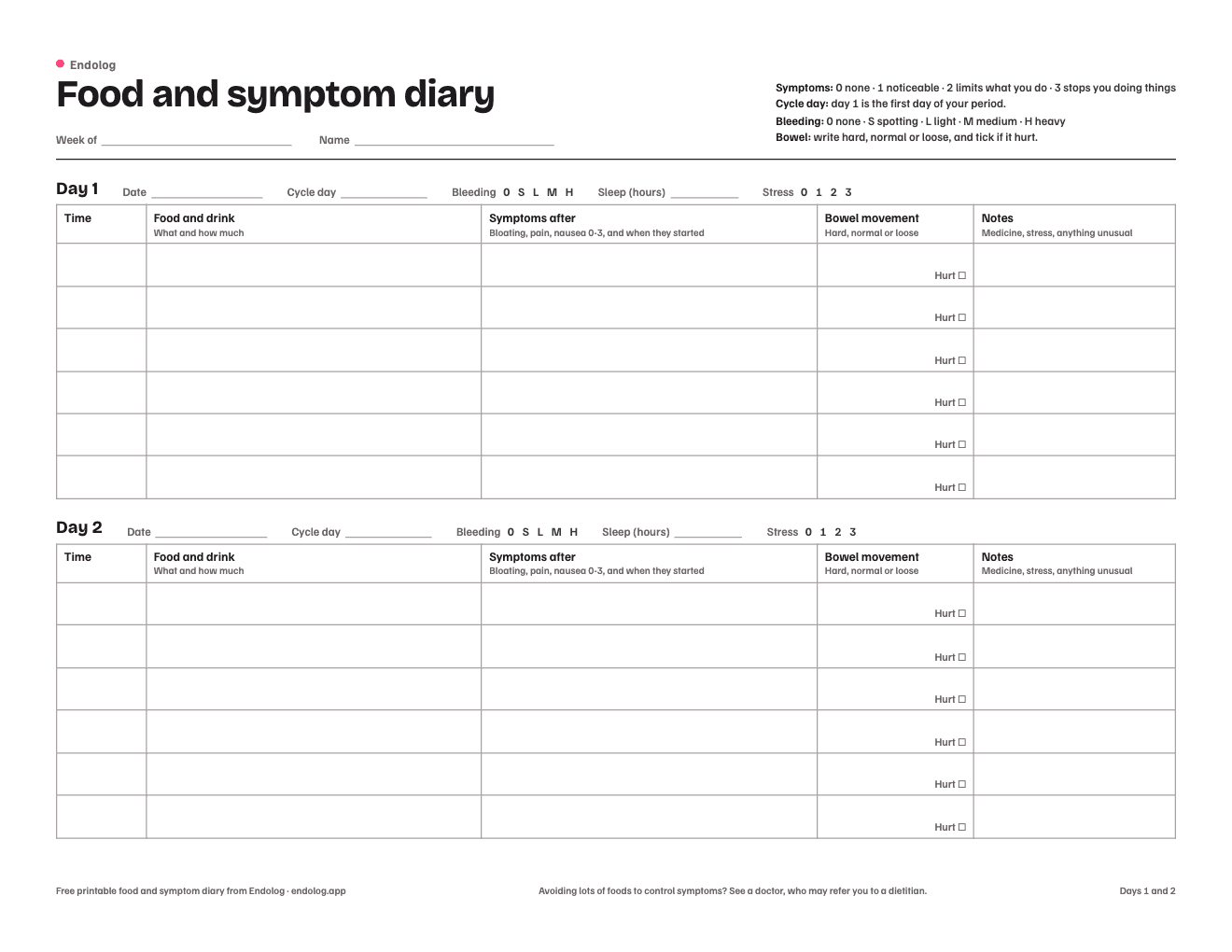
Bloating with endometriosis can follow a meal, your cycle, or both. A diary shows which. For gut symptoms, keep a diary of what you eat and any symptoms you get, so you can find the things that cause them.
For each meal or drink, write down:
- The time, what you ate and drank, and how much
- Your bloating from 0 to 10, and when it started
- Other symptoms, such as pain, nausea or wind
- Bowel movements: hard, normal or loose, and if it hurt
- Your cycle day, and if you are bleeding
Keep the diary for at least a week. Then compare a week with your period and a week without. Take the diary to your doctor or dietitian. It shows them if your bloating follows food, your period or both. If you start a low-FODMAP diet, use the same diary in the reintroduction phase, when you add foods back one at a time.
Print the free food diary for bloating. It has 7 days, a 0 to 10 bloating column next to each meal, and a weekly review to take to your appointment.
If you prefer your phone, the Endolog app has a food log that records what you ate and how you felt after. You can also log digestive and bowel symptoms next to your cycle, and export a PDF report for your doctor.
When to see a doctor about bloating
See a GP if:
- You feel bloated regularly
- You changed your diet but you keep feeling bloated
- You lose weight without trying, or you have blood in your poo
Get an urgent appointment if you are bloated and you also have vomiting, diarrhoea or constipation, a stomach ache, a fever, a swelling or lump in your tummy, or you cannot pass urine, poo or wind.
Get emergency help if your tummy is swollen and you have a sudden, severe stomach ache, you vomit blood, or you have severe difficulty breathing.
FAQ: endo belly and diet
What should I eat for endo belly?
No single diet works for everyone. Low-risk changes such as smaller meals, fewer fizzy drinks and regular exercise can ease bloating. If bloating continues, ask your doctor about a low-FODMAP diet with a dietitian. A food diary for bloating shows which foods matter for you.
Does the low-FODMAP diet help endometriosis?
It can help the gut symptoms. In a small trial, 60% of women with endometriosis and gut symptoms improved on a low-FODMAP diet, against 26% on a control diet. The diet does not treat the endometriosis itself, and the evidence is still limited.
How long should I keep a food diary for bloating?
Keep it for at least a week. Two weeks are better, one with your period and one without, so you can see if bloating follows food, your cycle or both.
Can diet cure endometriosis?
No. No treatment can cure endometriosis at this time. Diet can ease some gut symptoms, and treatment from your doctor can help manage symptoms such as pain.
Related articles
Sources
- Abdominal bloating: an under-recognized endometriosis symptom, Journal of Obstetrics and Gynaecology Canada (2009)
- Clinical trial: effect of a 28-day low FODMAP diet on gastrointestinal symptoms associated with endometriosis (EndoFOD), Alimentary Pharmacology & Therapeutics (2025)
- Low-FODMAP diet for gastrointestinal symptoms in endometriosis: a systematic review, Nutrients (2026)
- Low FODMAP diet, Cleveland Clinic
- Bloating, NHS
- Diet, lifestyle and medicines for IBS (irritable bowel syndrome), NHS
- Endometriosis, NHS
This article is general information, not medical advice. Read how we write and check our articles in our editorial policy.
Explore this topic
Related articles

January 31, 2026
Endo Belly: Causes, Symptoms, and What Helps
What endo belly is, why endometriosis causes severe bloating, what to track, and the dietary, lifestyle, and medical options that actually help.
October 8, 2026
Norethindrone (Aygestin) for Endometriosis: What to Expect
Aygestin (norethindrone acetate 5 mg) is a progestin tablet for endometriosis. How it works, side effects, spotting, mood, period delay and what to track.
October 6, 2026
Ibuprofen or Naproxen for Period Cramps: Which and When
Ibuprofen for period cramps works about as well as naproxen. See how often to take each, when to start, who should avoid them and when to see a doctor.
October 5, 2026
Heating Pads for Endometriosis and Period Pain: Safe Use
How to use a heating pad for endometriosis and period pain: how hot, how long, where to put it, why not to sleep on it, heat rash, and when to see a doctor.
October 4, 2026
Cramps After Your Period: Causes and When to Worry
Cramps after period ends can be leftover womb cramps or ovulation, or a sign of endometriosis, a cyst or infection. Learn the causes and when to worry.
October 3, 2026
What Helps With Period Cramps? Options With Evidence
What helps with period cramps: anti-inflammatory painkillers taken early, heat, exercise and hormonal birth control. See the evidence and when to get help.
