Orilissa (Elagolix) for Endometriosis: What to Expect and What to Track
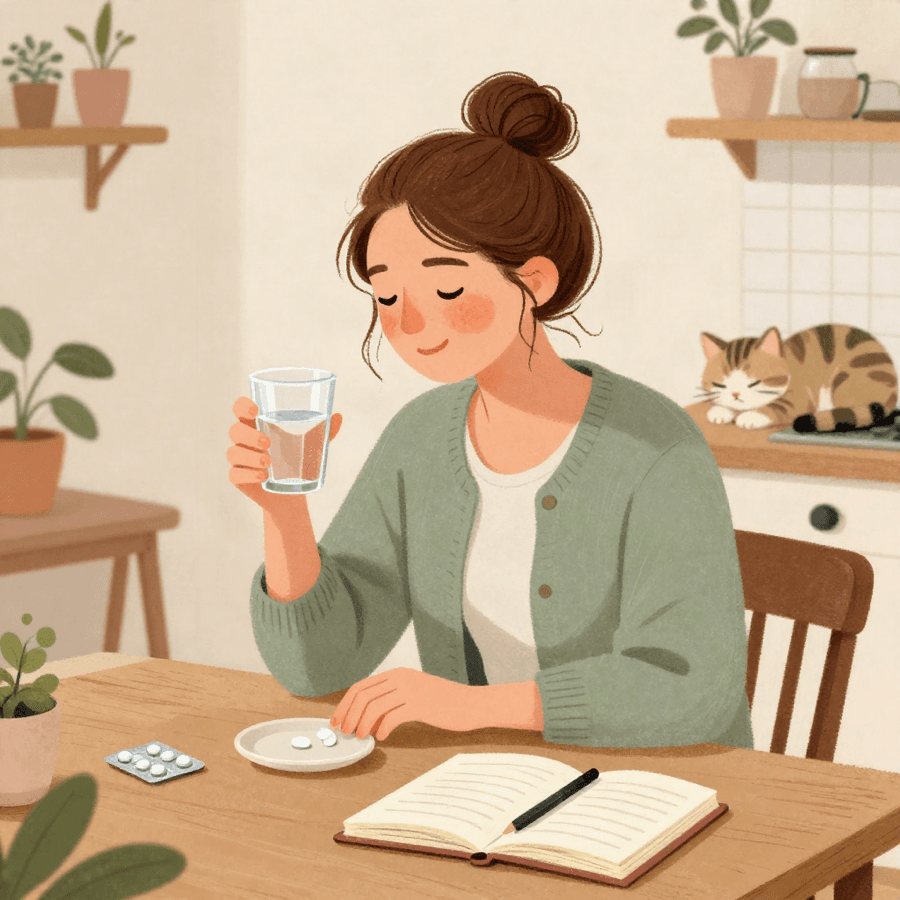

Orilissa (elagolix) is a daily tablet for moderate to severe endometriosis pain. It blocks the signal from your brain that tells your ovaries to make oestrogen (estrogen in the US), and endometriosis tissue needs that hormone to grow and hurt. You can take it at 150 mg once a day for up to 24 months, or at 200 mg twice a day for up to 6 months.
If your doctor has offered it, this guide covers how well it works, the side effects, the bone and mood warnings, contraception, and what to write down each week. It is general information and not medical advice. Your own doctor decides what is right for you.
For a comparison of all the main treatments, see our guide to endometriosis treatment options. This page is only about Orilissa.
What Orilissa is and how it works
Elagolix is a GnRH antagonist. GnRH is the hormone that starts the chain that ends with your ovaries making oestrogen. Elagolix sits on the GnRH receptor and lowers oestrogen in a dose-related way, from partial to nearly full suppression. In the phase 3 trials, median oestradiol fell to about 42 pg/mL on 150 mg once a day and about 12 pg/mL on 200 mg twice a day.
Because of their side effects, GnRH antagonists are a second-line choice. Doctors may offer them when hormonal contraceptives or progestogens have not helped.
The two doses and the time limits
The limit on how long you can take it depends on the dose, because of bone loss. Here are the dose limits:
| Dose | Longest use | Notes |
|---|---|---|
| 150 mg once a day | 24 months | The usual starting dose |
| 200 mg twice a day | 6 months | A doctor may consider it for pain during sex (dyspareunia) |
| 150 mg once a day, moderate liver impairment | 6 months | The 200 mg dose is not recommended |
If you miss a dose, take it the same day as soon as you remember, then go back to your usual schedule. Never take more than one 150 mg tablet a day, or two 200 mg tablets a day.
How well does it work
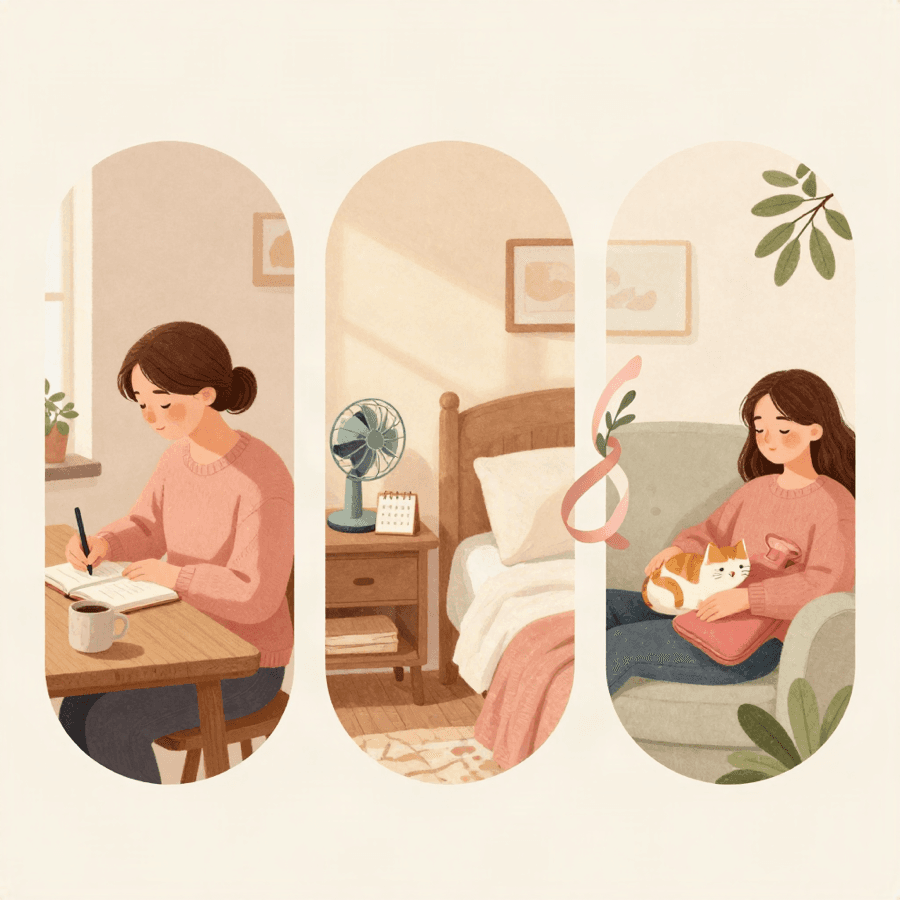
From left to right: writing a daily note, watching for hot flashes at night, resting when pain is high.
Two large 6-month trials compared both doses with a dummy tablet (placebo) in more than 1,600 people with surgically diagnosed endometriosis. At 3 months, more people had a clear drop in pain on elagolix:
- Pain with periods. In the first trial, 46.4% on 150 mg and 75.8% on 200 mg twice a day had a clinical response, against 19.6% on placebo. The second trial gave 43.4%, 72.4% and 22.7%.
- Pelvic pain between periods. About 50% on 150 mg and 55% to 58% on the higher dose had a clinical response, against 36.5% on placebo in both trials.
A clinical response meant a meaningful drop in the daily pain score, with the same or less use of rescue pain medicine. The gains were kept at 6 months. In the extension studies, people who kept going to 12 months still had lasting pain relief.
The numbers also show that the medicine does not work for everyone. Between periods, about a third of people on placebo also improved, and about half on elagolix did not reach a clinical response. If your pain has not moved after a few months, that is useful news for your doctor.
Common side effects
Elagolix lowers your oestrogen, so most side effects look like menopause symptoms. These were the most common side effects in the trials (150 mg once a day, 200 mg twice a day, placebo):
| Side effect | 150 mg | 200 mg twice a day | Placebo |
|---|---|---|---|
| Hot flashes | 24% | 46% | 9% |
| Headache | 17% | 20% | 12% |
| Nausea | 11% | 16% | 13% |
| Trouble sleeping | 6% | 9% | 3% |
| Mood changes or mood swings | 6% | 5% | 3% |
| No periods | 4% | 7% | under 1% |
| Low mood or depression | 3% | 6% | 2% |
| Anxiety | 3% | 5% | 3% |
| Joint pain | 3% | 5% | 3% |
Most hot flashes in the trials were mild or moderate. Blood fat (lipid) levels also went up more than on placebo.
Liver tests can change too. Blood tests in the trials showed dose-related rises in a liver enzyme (ALT). Tell your doctor at once if your skin or eyes turn yellow.
Bone density and mood warnings
Bone density
Low oestrogen thins bone over time. Orilissa lowers bone density, and the loss grows with dose and with time. The loss may not fully reverse after you stop. Nobody knows yet how this changes the chance of a broken bone later in life. That is why the dose limits above exist.
Ask your doctor about a bone scan if you have had a fracture from a small fall or have other risks for bone loss. Calcium and vitamin D may help everyone who takes it, though this was not tested.
Mood
Thoughts of suicide, suicidal behaviour and worse mood disorders happened in people taking Orilissa, including one death by suicide in the trials. Get help right away if you have thoughts of harming yourself. In the US, call or text 988. Call your doctor soon if you have new or worse low mood, anxiety or other mood changes. Our article on endometriosis, depression and anxiety has more on how pain and mood link.
Who should not take Orilissa
Orilissa must not be used if you:
- Are pregnant
- Have known osteoporosis
- Have severe liver disease
- Take a medicine that blocks a liver transporter called OATP1B1 and raises elagolix levels a lot, such as cyclosporine
- Have had an allergic reaction to Orilissa
Tell your doctor about every other medicine you take, including supplements.
Contraception while you take it
Orilissa is not a contraceptive. In a 3-cycle study, ovulation still happened in about 50% of cycles on 150 mg and about 32% on 200 mg twice a day. Lighter or missing periods can also hide an early pregnancy.
Use effective non-hormonal contraception, such as condoms, during treatment and for 28 days after your last tablet. Contraceptives with oestrogen may make Orilissa work less well, and progestin pills may work less well for contraception. Take a pregnancy test if you think you could be pregnant, and stop Orilissa if you are.
After you stop, your cycle usually returns. After 6 months on 150 mg, 59% had a period within 1 month, 87% within 2 months and 95% within 6 months.
What to track day to day
A daily note gives you and your doctor the answer to one question: is the pain relief worth the side effects? The trials measured response with a daily pain diary, and you can do the same at home. Before you start, write down one week of your usual symptoms if you can. It gives you something to compare with. For help with scoring, see how to describe period pain.
Each day, or at least each week, write down:
- Pain score. Your worst pain from 0 to 10, in two groups: on bleeding days and on other days. Add what the pain stopped you doing.
- Rescue medicine. Which pain relief you took and how often. Less use is a sign that the medicine helps.
- Bleeding. Spotting, lighter periods or no bleeding. Note the date of any bleeding.
- Hot flashes and night sweats. How many a day, and how bad.
- Mood. Low, anxious or irritable days. Note any thoughts of harming yourself and tell someone at once.
- Sleep. Nights with poor sleep.
- Other side effects. Headache, nausea, joint pain or anything new.
- Missed tablets. Any day you missed a dose.
Endolog is a pain and symptom diary for endometriosis. You log pain, bleeding, mood, sleep and notes on the days they happen, and you have a record to show at your review. A paper notebook works too.
When to call your doctor
Get emergency help now if you have thoughts of harming yourself. In the US, call or text 988.
Call your doctor soon if:
- Your low mood, anxiety or mood swings get worse
- Your skin or eyes turn yellow
- You could be pregnant
- Hot flashes or poor sleep make daily life hard
- You have a broken bone after a small fall
Talk to your doctor at your review if:
- Your pain has not gone down
- The side effects outweigh the relief
- You are near the end of the time limit for your dose and want to plan what comes next
Talk to your doctor before you stop taking it.
Frequently asked questions
What is Orilissa used for?
The FDA approved it for the management of moderate to severe pain from endometriosis.
Is Orilissa a hormone?
It is a hormone-lowering medicine. It does not add a hormone. It blocks the GnRH receptor and lowers oestrogen.
How long can I take Orilissa?
Up to 24 months at 150 mg once a day, and up to 6 months at 200 mg twice a day, because of bone loss.
Will Orilissa stop my periods?
It can lighten or stop them. In the trials, no periods was reported by 4% to 7% as a side effect. Do not count on missing periods as a sign that you are not pregnant.
Can I use Orilissa as birth control?
No. Use non-hormonal contraception during treatment and for 28 days after.
Does Orilissa affect fertility later?
Most people had a period again within 2 months of stopping. Fertility itself was not measured. If you plan a pregnancy, ask your doctor.
This article is for general information. It is not medical advice and does not replace advice from your own doctor, who decides what treatment is right for you. If you think you have an emergency, call 911.
Sources
- ORILISSA (elagolix) tablets: prescribing information and Medication Guide, U.S. Food and Drug Administration (FDA) label, via DailyMed, National Library of Medicine
- Treatment of endometriosis-associated pain with elagolix, an oral GnRH antagonist (Taylor HS et al. New England Journal of Medicine, 2017), New England Journal of Medicine
- Long-term outcomes of elagolix in women with endometriosis: results from two extension studies (Surrey E et al. Obstetrics & Gynecology, 2018), Obstetrics & Gynecology
- ESHRE guideline: endometriosis (Becker CM et al. Human Reproduction Open, 2022), European Society of Human Reproduction and Embryology (ESHRE)
This article is general information, not medical advice. Read how we write and check our articles in our editorial policy.
Explore this topic
Related articles

September 24, 2026
Dienogest (Visanne) for Endometriosis: What to Expect and What to Track
Dienogest (Visanne) is a daily progestogen tablet for endometriosis pain. Learn where it is sold, how often spotting and other side effects happen in the first 3 months, how long pain relief can take, what to track each week and when to call your doctor.

September 25, 2026
Cramps but No Period: Causes and When to See a Doctor
Cramps but no period? Take a pregnancy test if you could be pregnant. Learn the other causes, from ovulation to endometriosis, and when to see a doctor.

September 24, 2026
How to Describe Period Pain (to a Doctor, a Partner or a Boss)
Describe period pain with three things: what it feels like, where it is, and what it stops you doing. Get a word bank, a 0 to 10 scale based on your day, a one-line script for your doctor, and an honest look at the heart attack comparison.

March 4, 2026
Where Is Ovary Pain Felt? Location, Spread, and Causes
Ovary pain is felt low in the tummy on one side, and it can spread to the back, hip, or thigh. Learn what it can mean, including in early pregnancy.

March 3, 2026
What Triggers Endo Flare Up? 12 Common Triggers to Watch
Discover common endometriosis flare triggers from inflammatory foods to stress. Learn how to identify your personal patterns and manage chronic pelvic pain.

March 2, 2026
Painful Bowel Movement During Period: Causes and Relief
A painful bowel movement during your period often comes from prostaglandins. Learn when it can point to endometriosis, what helps and when to see a doctor.
